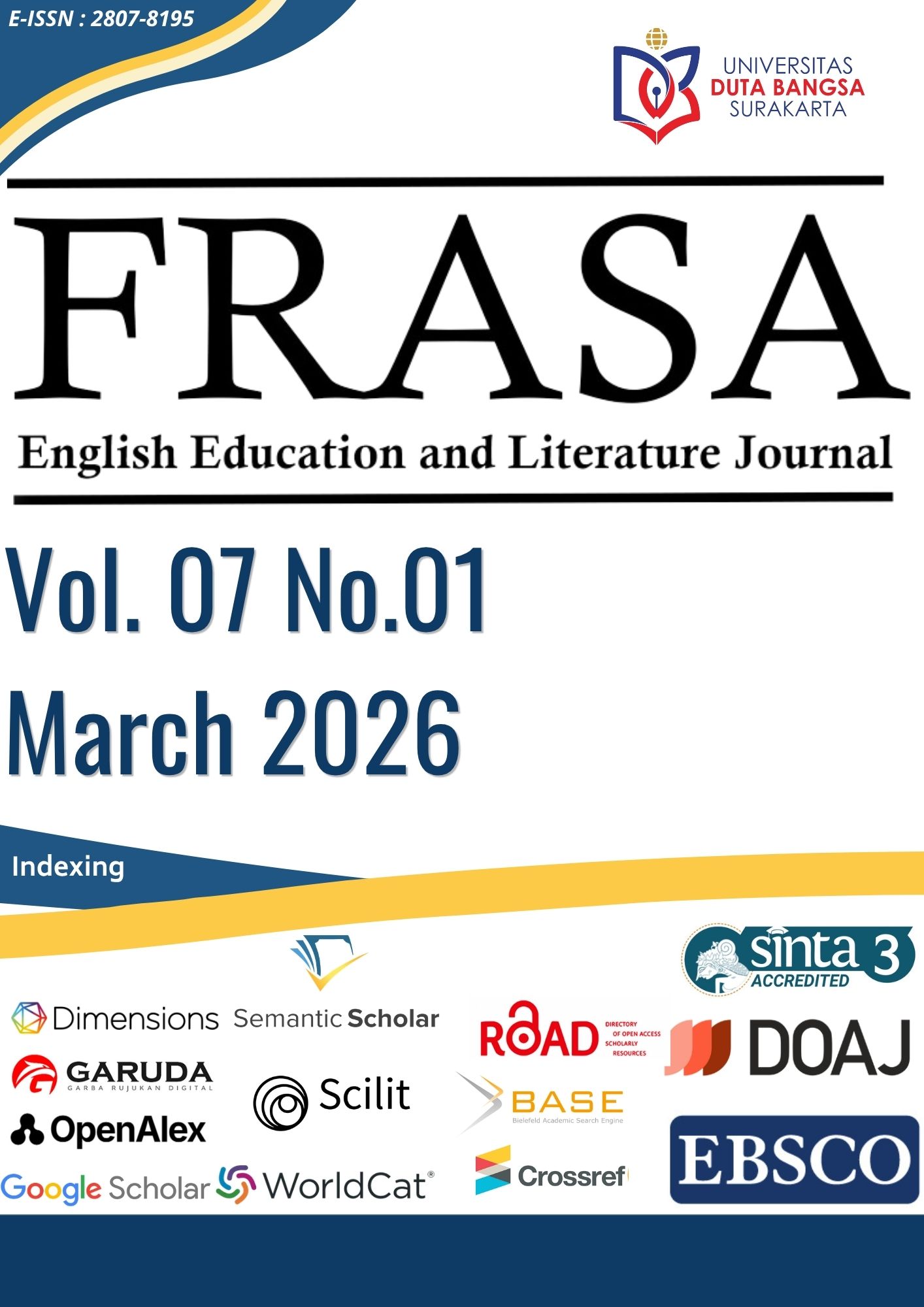
MAXIMIZING JUNIOR HIGH EFL SPEAKING: THE IMPACT OF ROLE PLAY ON CLASSROOM COMMUNICATION ACHIEVEMENT
DOI:
https://doi.org/10.47701/frasa.v7i1.5095Keywords:
Role Play, Speaking Proficiency, Secondary Education, English Language Instruction, Student MotivationAbstract
Speaking proficiency in English is a fundamental aspect of communicative competence and academic achievement; however, many junior high school students show limited progress due to the lack of interactive and communicative teaching strategies. This study aims to examine the effectiveness of the role-play technique as a pedagogical intervention to enhance students’ speaking skills among first-year learners at SMPN 03 Karang Ploso Satu Atap. The research employed a quasi-experimental design involving 25 students who participated in pre-test and post-test assessments covering four components of speaking ability, namely fluency, vocabulary, pronunciation, and grammar. The quantitative results indicated a substantial improvement in students’ speaking performance, with the mean score increasing from 53.6 in the pre-test to 63.2 in the post-test. The statistical analysis using a t-test revealed that the obtained value (t = 7.10) exceeded the critical value (t = 2.064), confirming that the improvement was statistically significant. These findings demonstrate that role play is an effective instructional technique for promoting speaking proficiency, increasing students’ motivation, and encouraging active participation in the learning process. Therefore, this study recommends the integration of role-play activities into English language teaching practices to strengthen students’ communicative competence at the junior secondary school level.
Downloads
References
Akhmad, A. (2005). Smart steps. Ganeca Exact.
Ary, D., Jacobs, L. C., & Razavieh, A. (2002). Introduction to research in education (6th ed.). Wadsworth.
Ayiz, A., & Tauchid, A. (2025). Enhancing public speaking skills among EFL learners through the peer teaching method: A mixed-methods study. ETERNAL, 16(1), 125–137. https://doi.org/10.26877/eternal.v16i1.1124
Bachman, L. F., & Palmer, A. S. (1996). Language testing in practice. Oxford University Press.
Brown, H. D., & Abeywickrama, P. (2010). Language assessment: Principles and classroom practices (2nd ed.). Pearson Education.
Bruton, A., et al. (2000). Examining rater reliability in speaking assessment. Modern Language Journal.
Campbell, D. T., Cook, T. D., & Shadish, W. R., Jr. (2001). Experimental and quasi-experimental designs for generalized causal inference. Houghton Mifflin.
Douglas, D. (2010). Understanding language testing. Routledge.
Dwiyanti, A. (2023). The effectiveness of role play in improving speaking skill of EFL students. Jurnal Pendidikan Bahasa Inggris Proficiency, 7(1), 37–60.
Gallin, J. (2018). Quasi-experimental design in applied linguistics. Annual Review of Linguistics, 4, 211–231.
Harmer, J. (1983). The practice of English language teaching. Longman.
Katemba, C. V. (2023). Role-playing improves speaking proficiency skills. Acuity: Journal of English Language Pedagogy, Literature and Culture, 8(1).
Kaygısız, S., & Akar, H. (2025). Role-playing as an instructional technique in English as a foreign language: State-of-the-art review. Cambridge Journal of Education, 55(3), 441–467. https://doi.org/10.1080/0305764X.2025.2480579 (Taylor & Francis Online)
Ko, H. (2023). English oral proficiency measured by holistic and analytic assessments. English Teaching, 78(1), 59–73.
Larson-Hall, J. (2015). A guide to doing statistics in second language research using SPSS and R (2nd ed.). Routledge.
Larson-Hall, J., & Herrington, R. (2010). Statistical report reform in second language research: A case of experimental designs. JEELS, 8(2), 175–201.
Lee, J. (1995). Assessing speaking proficiency. Language Testing, 13(2), 110–124.
Nunan, D. (1990). Research methods in language learning. Cambridge University Press.
O’Malley, J. M., & Pierce, L. V. (1996). Authentic assessment for English language learners. Addison Wesley.
Rahayu, A. P. (2022). Improving speaking English ability using role play method for elementary students. English Teaching Journal and Research, 2(2), 23–39.
Renanda, C. A., Yunus, M., & Rachmawati, S. (2025). Improving speaking proficiency via role-play: An investigation from Indonesian secondary schools. Educasia, 10(2), 191–205. https://doi.org/10.21462/educasia.v10i2.348 (Educasia)
Santoso, I. B. (2024). Improving students’ confidence in speaking skills using scripted role play. Asian EFL Journal, 26(3), 180–195.
Sarifudin, S., & Setyawan, W. H. (2025). The effect of using role-play method in improving speaking skills of basic level students. Prima Magistra: Jurnal Ilmiah Kependidikan, 6(1), 29–35. https://doi.org/10.37478/jpm.v6i1.5190 (E-Journal Universitas Flores)
Sari, S. O. (2023). The effectiveness of role play to improve English speaking ability. Repository IAIN Palu, 4(2), 40–50.
Stolarova, M., et al. (2014). Inter-rater reliability in oral assessment. Language Testing, 31, 95–105.
Sugiharto, M. (2025). Current trends in EFL speaking instruction. Jurnal Pendidikan Bahasa Inggris Proficiency, 7(1), 37–60. https://doi.org/10.32503/proficiency.v7i1.6531 (Ejournal Uniska Kediri)
Susanti, D. (2007). Using role play in teaching speaking (Unpublished undergraduate thesis). UIN Syarif Hidayatullah Jakarta.
Suryani, L. (2015). The effectiveness of role-play in teaching speaking. English Education Journal, 6(2), 45–59.
Wind, S. A., & Peterson, S. S. (2017). Reliability in language performance assessment.
Downloads
Published
Issue
Section
License
Copyright (c) 2026 Sulistyahadi Sulistyahadi

This work is licensed under a Creative Commons Attribution 4.0 International License.